
Business Loan Personal Guarantee | Risks & Liability
Table of Contents
Can you get a business loan without a personal guarantee in Singapore?
For most SMEs, the answer is no. All banks typically require directors or major shareholders to provide a personal guarantee (PG) for unsecured business loans.
A personal guarantee means that if the borrowing company defaults on its loan, the bank can pursue the guarantor personally for the outstanding debt covered by the guarantee, including applicable interest, charges and recovery costs.
This is particularly important for owners of private limited companies, who might otherwise assume their personal liability is limited to their investment in the company.
Why Do Banks Require Personal Guarantees for Business Loans?
A private limited company (Pte Ltd) is a separate legal entity from its directors and shareholders. Ordinarily, the company's debts are its own obligations, and shareholders are not automatically personally liable for them.
A personal guarantee changes this by providing the bank with an additional, enforceable commitment from the individuals behind the business.
Without a PG, a company that fails financially might be wound up with insufficient assets to repay its creditors. Its shareholders could subsequently establish another company without becoming personally responsible for the previous company's debts.
By requiring a PG, banks obtain additional recourse and ensure that key business owners have a personal financial commitment to the borrowing arrangement.
This requirement is not exclusive to unsecured loans. Banks usually also require directors' personal guarantees for secured business loans, including commercial and industrial property financing, even where the property itself is pledged as collateral.
The distinction is important: an unsecured business loan does not require a specific asset to be pledged as security, but that does not mean the directors have no personal liability.
Who Must Provide the Personal Guarantee?
Based on our experience handling SME loans applications since 2012, banks commonly require PGs from the key directors or major shareholders who control and operate the business.
Banks often seek guarantees from shareholders collectively representing at least 50%–51% ownership. However, these are practical underwriting requirements rather than a universal statutory threshold.
We have handled cases where banks accepted a key director holding no less than 30% shareholding as the personal guarantor.
These exceptions generally involved situations where the remaining shareholders are passive investors or sleeping partners who do not participate in the company's management or daily operations.
The bank's primary concern is identifying the key person actually responsible for running the business and obtaining that individual's guarantee.
Such exceptions are subject to individual bank approval. They should not be interpreted as a general waiver of personal-guarantee requirements.
As a general rule-of-thumb, majority shareholders (51% or more) providing personal guarantees should be regarded as the minimum commonly accepted norm for most banks.
Even though if there are 51% shareholders providing PGs, note that certain banks might still require any other individual shareholder who holds significant shares (i.e. 20% or more) to provide their PGs as well.
Do Sole Proprietors and Partnerships Need Personal Guarantees?
Sole proprietorships and ordinary partnerships have a different legal structure from private limited companies.
Because a sole proprietorship is not legally separate from its owner, the proprietor is already personally liable for a sole proprietor business loan. The same principle applies to partners in an ordinary Partnership entity.
A separate PG is therefore not necessary to establish that underlying personal liability, although banks may still require additional security or third-party guarantees.
Limited liability partnerships (LLPs), however, are separate legal entities and should not be confused with ordinary partnerships.
Source: ACRA – Choosing a Business Structure.
What Does a Personal Guarantee Cover?
Under a personal guarantee, the guarantor is personally liable for the outstanding debt covered by the guarantee, including unpaid loan principal, accrued interest, default interest, bank charges and legal recovery costs.
The actual extent of liability depends on the terms of the guarantee signed.
Personal guarantee requirement for business loans contains common provisions that SME owners should understand:
- Recovery without exhausting the company's assets: The bank may demand repayment from the guarantor without first pursuing all available recovery actions against the borrowing company.
- Continuing guarantee: The guarantee may remain in force notwithstanding partial repayments or changes to the financing arrangements.
- Interest and recovery costs: The guaranteed obligations may include interest, legal expenses and other charges incurred in recovering the outstanding debt.
- Changes to loan terms: Certain guarantees permit the bank to vary credit arrangements without automatically releasing the guarantor from liability.
- Set-off rights: Depending on the agreement, the bank may have rights to apply money held in the guarantor's accounts with that bank towards covered liabilities.
- Borrower and guarantor distinction: The borrower is typically the Pte Ltd company, while the personal guarantor is the managing director and/or majority shareholder.
- Event of default: Banks usually exercise the legal personal guarantee only after the event of a default. Banks and lenders might have different classification as to what constitutes an event of default; typically 90 days payment past due, or a breach of financial covenants.
These are just examples, not provisions that are necessarily identical across all banks.
Before signing, always read the guarantee itself, not just the business-loan letter of offer. Where the amount involved is substantial, consider obtaining independent legal advice.
What Happens if the Company Defaults on Its Business Loan?
When a company defaults, the bank may enforce the PG according to its terms.
Depending on the agreement and applicable recovery procedures, the guarantor may face a demand for repayment, legal proceedings and enforcement against personal assets.
Assets that may be exposed to lawful recovery include:
- Personal savings and bank balances
- Shares and investment holdings
- Privately owned vehicles
- Private residential or investment properties
- Other assets available for enforcement under Singapore law
A PG does not automatically give the bank ownership of these assets. Recovery must follow the applicable contractual and legal procedures.
Are HDB Flats and CPF Savings Protected?
Singapore law protects certain assets from creditors.
CPF savings held in CPF accounts are generally protected. HDB flats are also protected in bankruptcy proceedings where at least one registered owner is a Singapore citizen, subject to applicable legal conditions.
These protections are not absolute for every type of property or ownership arrangement. They do not extinguish the rights of a secured mortgage lender over property validly mortgaged to it.
For details, refer to the Ministry of Law's guidance on assets protected in bankruptcy.
Are Personal Guarantors Equally Liable Under a Joint-and-Several Guarantee?
No. Where two or more directors sign a joint-and-several personal guarantee (JSPG), the bank is not required to divide the debt equally among them.
Consider a company with two directors who jointly and severally guarantee a S$400,000 business loan.
If the company defaults with S$300,000 outstanding, the bank is not restricted to claiming S$150,000 from each director.
Subject to the guarantee terms, the bank can pursue either guarantor for the entire S$300,000 outstanding, or recover different amounts from each, without recovering more than the total debt owed.
Consequently, a director with substantial personal investments, savings or private property could face greater practical recovery exposure than a co-guarantor with fewer recoverable assets.
This applies regardless of whether both directors hold equal shares in the company.
A guarantor who pays more than their share may have separate contribution rights against another guarantor, but those rights do not necessarily restrict the bank's ability to recover the guaranteed debt.
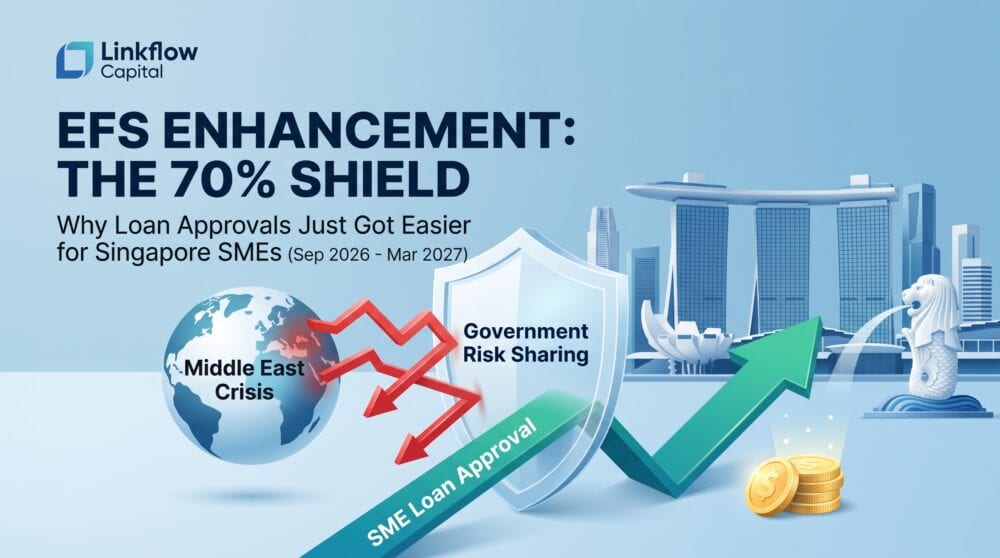
Does Enterprise Singapore’s Government Risk-Sharing Reduce PG Liability?
No. Risk-sharing under the Enterprise Financing Scheme (EFS) such as the SME Working Capital Loan does not mean the borrower or personal guarantors are liable for only the portion of the loan not covered by the government.
Enterprise Singapore shares part of the credit risk with participating financial institutions. This arrangement supports banks in extending financing to eligible businesses.
However, the borrower and guarantors remain responsible for 100% of the guaranteed debt, subject to their respective contractual obligations.
When a default occurs, participating financial institutions are required to undertake their standard commercial recovery procedures before claiming the applicable government risk-sharing support on unrecovered amounts.
The government risk-sharing arrangement is therefore between Enterprise Singapore and the participating financial institution, not a reduction of the borrower's repayment obligations.
Can You Remove Your Personal Guarantee After Selling or Exiting a Business?
Selling your shares or resigning as a director does not automatically discharge a personal guarantee on the company's outstanding business loan.
This is a common issue when business owners exit a company before its existing loans have been fully repaid.
A director who signed a PG for a five-year business loan will remain personally liable even after selling the business to a new owner in the third year.
Can a New Director Replace the Existing Personal Guarantor?
It is possible to request that the bank release an existing guarantor and accept a replacement PG from the incoming business owner.
However, approval is not automatic, and banks may decline such requests.
Based on cases we have handled, banks will typically reassess the borrowing arrangement before agreeing to a change of guarantor.
Factors include the incoming director's personal credit bureau records, financial standing and relevant management experience, particularly whether the new owner has experience operating a business in the same industry.
We have encountered cases where exiting shareholders requested to be discharged from their PGs, but the banks did not approve the proposed replacements.
More importantly, a substantial change in company ownership or management may trigger a review of the existing loan facility.
Depending on the loan agreement, a bank may require full repayment of the outstanding loan if it is unwilling to continue financing the business under the new ownership or management.
This creates an important consideration during a business sale.
Linkflow’s Practical Advice When Selling a Business
If you intend to sell your company while it still has outstanding bank borrowings, do not assume the buyer can simply take over the monthly repayments and replace your guarantee.
Discuss the proposed ownership change with the bank before completing the transaction.
We generally advise exiting business owners to consider earmarking part of the sale proceeds to redeem outstanding bank loans in full, including applicable settlement charges if any.
Obtain the bank's written confirmation that your personal guarantee has been formally discharged.
This can be a more reliable approach than relying on a new owner to continue servicing a loan for which you remain personally responsible.
A Singapore High Court decision, DBS Bank Ltd v Tong Shao Hwa [2012] SGHC 72, also illustrates that a change in shareholding does not by itself release a guarantor where the guarantee remains binding.
Can a Wealthy Guarantor Help a Company Qualify for a Business Loan?
A financially strong personal guarantor can strengthen a business loan application but does not replace the need for the applicant borrowing company to meet the bank's credit criteria.
For example, suppose a company has very weak cash flow, minimal revenue or insufficient operating history, but an affluent high-net worth shareholder with significant investments and private assets is willing to provide a PG.
The bank may derive additional credit comfort from the guarantor's financial standing.
However, it will still need to assess whether the borrowing company has the underlying ability to service the proposed loan.
In our experience, a high-net-worth guarantor alone will rarely overcome a fundamentally weak business credit profile for a conventional unsecured bank loan.
The reverse is also true.
A business with strong revenue, stable cash flow and healthy profitability may still have its loan application declined because of poor personal credit conduct by its key director or guarantor.
This is why banks assess business owners' personal credit bureau records, individual income and existing financial commitments alongside the company's cash flow and financial figures.
Read more: How Directors' Credit Bureau Records Affect Business Loan Eligibility.
When Is a Corporate Guarantee Required in Addition to a PG?
A corporate guarantee (CG) is a guarantee provided by another company rather than an individual.
For example, where a smaller subsidiary depends heavily on the financial support of a stronger parent company, the bank may request a corporate guarantee from the parent company.
This provides another source of contractual recourse should the borrowing subsidiary default.
Depending on the credit structure, banks may require both a corporate guarantee from the parent company and personal guarantees from the key directors or shareholders.
Case Study: Doctor Personally Liable for S$600,000 Clinic Loan Guarantee
A Singapore High Court judgment provides a practical illustration of the consequences of signing a personal guarantee.
In Ethoz Capital Ltd v Goken Aesthetics Practice Pte Ltd and others [2026] SGHC 140, a medical aesthetics clinic obtained a S$600,000 term-loan facility from ETHOZ Capital under an Enterprise Singapore financing scheme.
A doctor who was also a director and shareholder of the clinic signed as a personal guarantor. He alleged he had been informed by his boss that signing the PG was just a formality.
After the clinic defaulted, the lender pursued the guarantors.
The doctor disputed his personal liability, claiming, among other things, that he had been misled about the implications of signing the guarantee.
The High Court rejected his defence and counterclaim in July 2026.
One significant consideration was that the doctor had requested to be replaced as a guarantor shortly after signing the agreement, indicating that he understood the personal liability involved.
The court allowed the lender's claim against him under the guarantee.
The judgment established the doctor's liability but it did not establish that he had already paid the entire original S$600,000 facility.
The lesson here is that a business loan taken entirely for company purposes can still create enforceable personal liability for the individual who signed its guarantee.
Read the full Singapore High Court judgment.
Should Personal Guarantees Discourage SME Owners From Taking Business Loans?
A PG involves real financial risk. But that does not mean businesses should avoid debt financing altogether.
The more important question is whether the financing serves a sound commercial purpose and whether the business can reasonably service the repayments.
If loan proceeds are deployed into productive business purposes, such as inventory purchases, equipment investment, working-capital support or expansion capital, and the expected returns justify the borrowing costs and risks, taking on debt can be a sensible, calculated risk.
On the other hand, borrowing to fund personal consumption, cover persistent structural losses or prolong an unsustainable business model deserves much more caution.
Business loan financing also offers advantages over equity fundraising.
Debt allows founders to retain ownership and control of their businesses. A conventional term loan has a defined repayment period, after which the borrowing obligation ends when all amounts due have been paid.
Equity funding may remove the need for interest repayments and personal guarantees, but it typically requires business owners to give up a share of future earnings and business value via equity dilution.
For many traditional SMEs, particularly those outside technology or high-growth sectors, attracting external equity investors can also be exceedingly difficult.
Business debt can therefore be a more practical and potentially less expensive source of financing leverage for a business with sustainable cash flow, although it carries fixed repayment obligations and the possibility of personal liability.
The objective is not to avoid every financial risk, but to take calculated risks that the business can reasonably support.
If your business is exploring additional financing, an experienced and competent business loan consultant can advise you on the repayment obligations, borrowing costs and guarantee requirements before proceeding.