SME Support Package: Working Capital Loan 70% Risk-Share
Table of Contents
On 29 July 2026, the government announced a second support package of around $900 million to help households and businesses cope with the continuing situation in the Middle East.
Most of the coverage focused on the SME Cash Grant, which is understandable. Cash in the bank is easy to understand and easy to headline.
But if you run a business that will need financing in the next twelve months, the cash grant is the smaller story. The measure that matters more is a temporary enhancement to the Enterprise Financing Scheme, and it comes with an expiry date.
Quick Summary
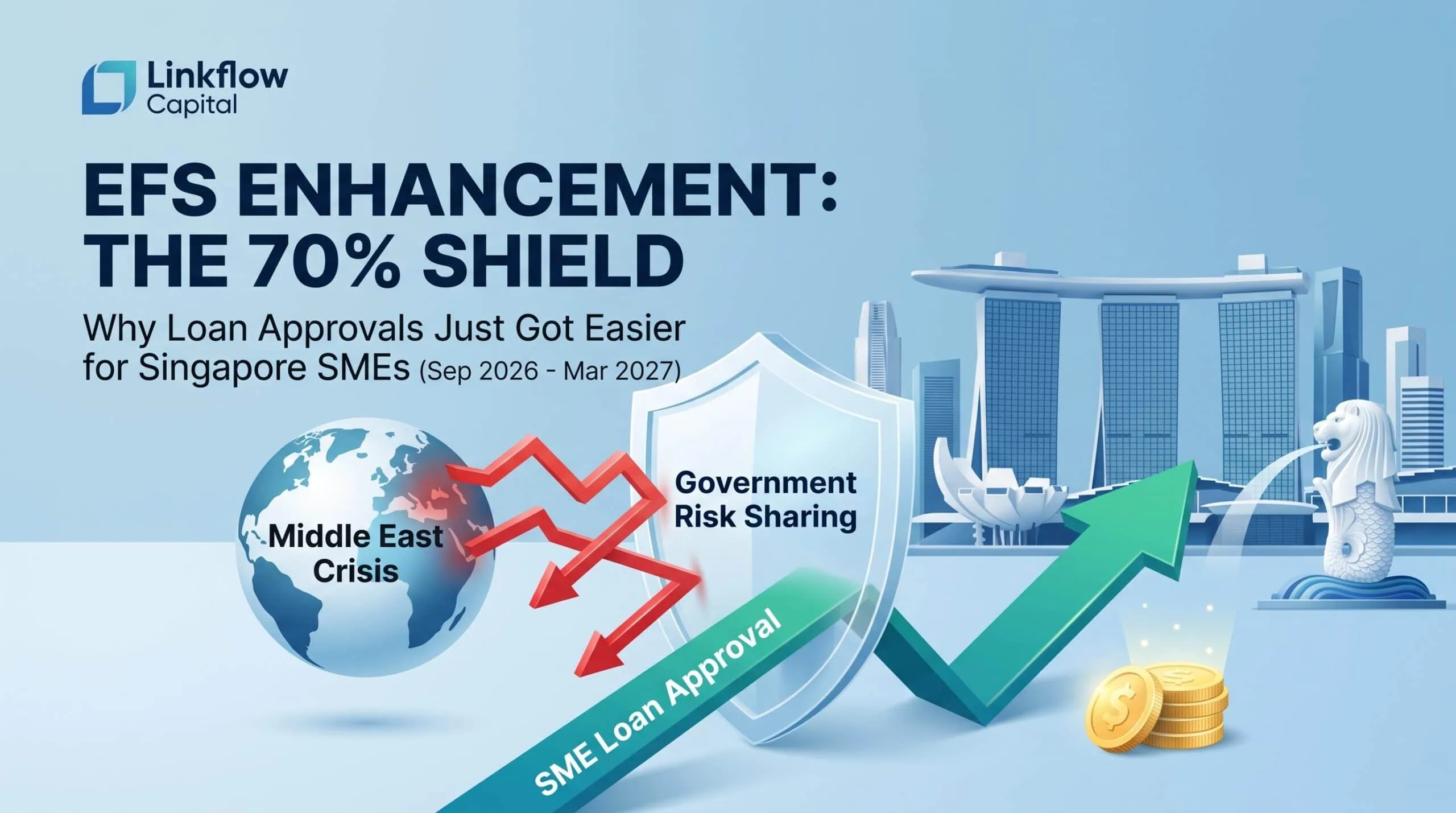
From 1 September 2026 to 31 March 2027, Enterprise Singapore will share 70% of the default risk on the EFS SME Working Capital Loan and the EFS Project Loan, up from the usual 50%.
This does not change how much you can borrow or what interest rate you pay. It potentially influences banks' credit underwriting and general credit conditions is expected to be more accomodative for SMEs .
The window is six months. After 31 March 2027, the risk-share reverts to 50%.

What was announced for businesses?
The package had three components for businesses, delivered by Senior Minister of State for Trade and Industry Low Yen Ling.
1. A time-bound enhancement to the Enterprise Financing Scheme
The government risk-share rises from 50% to 70% for two facilities: the EFS SME Working Capital Loan and the EFS Project Loan. This runs from September 2026 to March 2027.
There is a second change to the Project Loan that has been almost entirely overlooked. The Project Loan currently finances secured overseas projects. Its coverage will be expanded to also support domestic projects undertaken by local construction enterprises.
If you are a contractor with a secured local project and you have been struggling to fund the working capital gap between progress claims, this is directly relevant to you.
2. A one-off SME Cash Grant 2026
Active SMEs with at least one local employee will receive $500 per local employee, capped at $2,500 per company. Sole proprietorships, partnerships and LLPs with at least one local business owner but no local employees will receive a flat $500. Disbursement is in November 2026.
For a company with five or more local staff, that is $2,500. Useful, but it will not move the needle on a cashflow problem of any real size.
3. Rental support for hawkers and market stallholders
Stallholders in markets and hawker centres managed by the government and government-appointed operators will receive support disbursed over six months, from September 2026 to February 2027. Cooked food stalls receive $1,200 and market stalls receive $600.
Why the risk-share change matters
Here is the mechanic in plain terms.
Under EFS, Enterprise Singapore does directly conduct lending to SMEs. The banks does. What Enterprise Singapore does is agree to absorb a share of the loss if a SME defaults.
At 50% risk-share, a bank that writes off a $500,000 loan is exposed to $250,000. At 70%, that exposure drops to $150,000.
Banks' credit approvers price risk. When the downside on a facility shrinks by 40%, marginal applications that would previously have been declined start to look approvable.
That is the whole point of the measure, and it is why the government reaches for risk-share adjustments during downturns rather than simply handing out cash.
What this does not mean:
- It is not free money. You still repay 100% of the loan. The risk-share sits between the bank and Enterprise Singapore, entirely in the background.
- It is not a guarantee of approval. Banks still run their own credit assessment. A company with low credit standing will still be declined.
- It does not lower your interest rate directly. Rates remain subject to each financial institution's own risk assessment.
- Young enterprises gain the least. Companies formed within the past five years with at least one employee and majority individual ownership already qualified for 70% risk-share. If that is you, this announcement changes nothing on the WCL.
SME Working Capital Loan at a glance
| Item | Detail |
|---|---|
| Maximum loan quantum | $500,000 per borrower, with a $5 million borrower group limit |
| Maximum repayment period | 5 years |
| Risk-share | 50% normally. 70% from 1 Sep 2026 to 31 Mar 2027 |
| Interest rate | Set by the participating financial institution |
| Local equity | At least 30% held by Singaporeans or PRs |
| SME definition | Group revenue up to $100 million, or maximum 200 employees |
| Group sales cap | Group annual sales turnover not exceeding $500 million |
There are 16 participating financial institutions on the WCL scheme. Each assesses applications differently.
The same company can be declined by one and approved by another in the same month, which is why applying to a single bank and stopping there is usually a mistake.
What to do between now to March 2027
Work out whether you will need financing at all. Look at your next two quarters of receivables against your fixed commitments. If there is a gap, or if a large order would create one, you have a case for applying.
Get your documents in order early. Most banks will require latest year financial statements, recent months bank statements and a clear purpose of financing.
Assembling these takes longer than people expect, and a rushed submission with gaps invites questions that slow everything down.
Apply from a position of strength. This is the part most owners get wrong. Credit assessment looks at your position at the point of application.
A company applying while its numbers still look healthy presents very differently from the same company applying three months later with a strained cash conversion cycle.
The best time for an application is when you do not need to.
Do not apply to every bank at once. Multiple simultaneous applications show up and can work against you. A considered approach across two or three appropriate lenders beats a scattergun.
Note the date the risk-share applies. The enhancement runs to 31 March 2027. Given that bank processing on a working capital facility typically takes a few weeks, leaving your application to March is cutting it fine.