US Tariffs Impact on SMEs – Calibrating SME Financing Rates
Table of Contents
Announced in July 2025, the Singapore government will roll out the Business Adaptation Grant for businesses on October 2025 in response to the impact of US global tariffs uncertainties.
The Singapore Economic Resilience Taskforce (SERT) announced that the Business Adaption Grant will provide up to S$100,000 in co‑funding to assist local SMEs affected by escalating US tariffs.
This initiative primarily supports exporters and manufacturers in restructuring their supply chains, logistics, and operational configurations, thereby mitigating the immediate impacts of these tariffs.
The Business Adoption Grant will support advisory services related to free trade agreements, trade compliance, legal and contractual matters, supply chain optimization and market diversification
For businesses with local or overseas manufacturing operations, the grant can help to defray reconfiguration costs such as logistics and inventory-holding expenses.
Contextualizing the Need
The imposition of US tariffs, specifically targeting key sectors such as electronics, semiconductors, and pharmaceuticals, has sent significant ripples through Singapore’s SME community.
The Business Times highlighted that over a third of Singaporean SMEs are already experiencing pain from tariffs, with around 90% bracing for secondary ripple effects. ASME (Association of Small & Medium Enterprises) has also quoted that SMEs are facing cash flow instability due to the tariff’s impact, as financing rates for SMEs are still not low enough.
Singapore recorded a robust better-than-expected GDP growth of 4.3% in the first half of 2025, driven by front-loading activities as companies raced ahead of tariff implementations.
However, economists warn of a slowdown in the second half, attributable directly to the tariffs' dampening effect on global trade demand and the tapering of front loading activities in first half 2025.
Overseas buyers brought forward orders and shipments into H1 to avoid the effective start of broad US tariffs from August. As a result, inventories accumulated upstream in the supply chain and at end‑markets.
This front loading of purchases will most certainly dissipate in second half of 2025 as importers run down excess stocks, implying a softer activity profile into year end.
Already in July, key exports to US plunged by 42.7% and Singapore's non-oil domestic exports (Nodx) contracted by 4.7%, according to a Straits Time report.
The MAS and MTI also forecast a sharp slowdown in H2 2025, citing trade uncertainties and weakening external demand.
Broader Economic Implications and the Need for Interim Financing
Singapore’s role as a global trade hub with total trade flows amounting to roughly three to four times its GDP amplifies any shock to international commerce and trade.
Singapore’s export‑driven SMEs face concrete risks:
- Higher compliance costs due to U.S. tariffs on electronics, semiconductors and pharmaceuticals.
- Supply‑chain delays or rising logistics costs from redistribution efforts.
- Domestic ripple effects as weaker global demand slows sales, jobs creation, investment, and sentiment, even among non-US exporting firms.
SMEs that do not export directly to the US could also face spillover second and third order impacts:
- Aggregate Demand Contraction: As US tariffs dampen demand for Asian exports, multinational suppliers in Singapore see order books shrink, filtering down to component and service providers across the supply chain. SMEs have less room than larger corporates to absorb tariffs costs or pass them to consumers.
- Trade Finance Tightening: Banks may tighten trade credit terms in response to heightened risk, increasing working capital pressures and lowering credit availability on import‑export intermediaries. SMEs might also find it harder to access financing due to heightened risk posture from banks’ credit underwriting.
- Domestic Consumption Slowdown: Slower export performance can weigh on domestic incomes and consumer sentiment, further reducing local demand for SMEs in retail, F&B, and services. Jobs creation and wage growth might also slow due to uncertainties, exacerbating the pressure on domestic facing SMEs.

In this environment, access to short‑term interim financing becomes vital. SMEs require bridge capital to cover cashflow gaps while they pivot supply chains, seek alternative export markets, or invest in product diversification.
Without timely financial support, viable businesses risk insolvency simply due to temporary liquidity constraints.
Already, Singapore has hit a 15 year high in the number of compulsory business liquidations – 307 in 2024. For the first half of 2025, 187 firms were wind up by the courts, up from 146 in first half of 2024, and 95 the year before. (Source: CNA)

Cash flow problems are a key reason why companies go bust, said liquidators and analysts. Businesses also dealt with rising interest rates between 2022 and 2024, with business loan rates staying elevated in 2025.
Employment claims from employees are also rising with higher job losses and firms facing financial difficulties. This could point to an undercurrent of higher job turnovers from business closures and firms facing cashflow issues delaying salary payments.

Source: Business Times
SME Financing Challenges: Disconnect with Domestic Rates
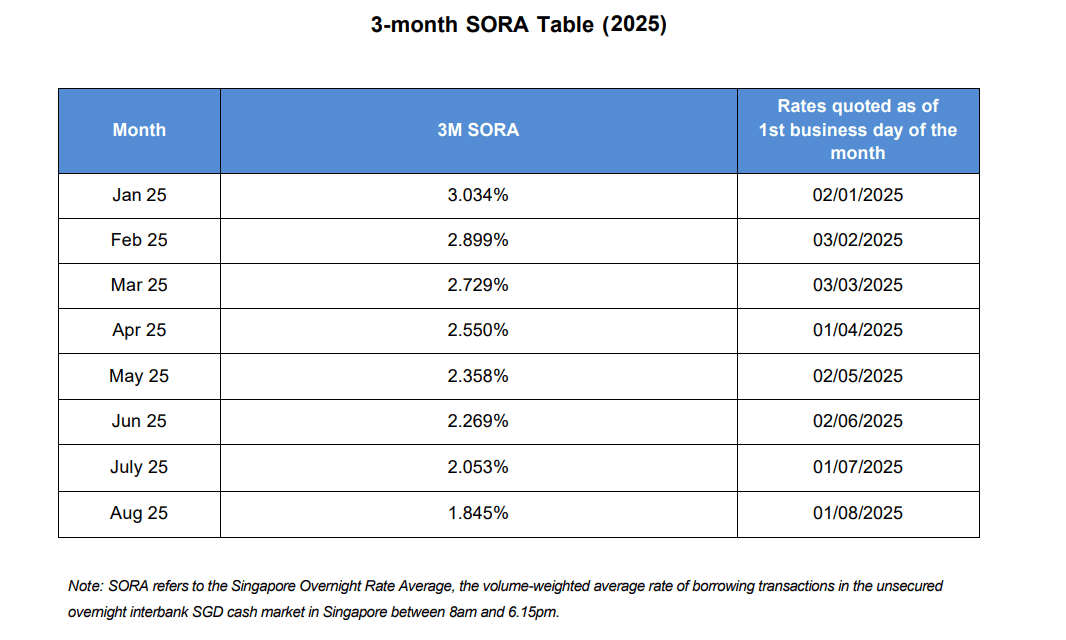
Despite the domestic interest rate benchmark, the Singapore Overnight Rate Average (SORA), declined steadily from an average of 3.7% in January 2024 to 1.845% by August 2025 (a 50% drop). SME borrowing costs though have not seen comparable reductions.
SORA is commonly used to price variable interest rates on housing mortgage loans in Singapore.
Source: POSB
Linkflow Capital's 2024 SME Finance Accessibility Survey found SME financing costs remained stubbornly high at 8.47%, hitting a 10 year high. Preliminary flash estimates from our internal date for first half 2025 saw an average interest rate of 8.28%, barely budging from 2024’s high.
The rates shared above are for non-revolving unsecured term loans, which is the most common form of financing facility SMEs, especially micro-SMEs, will apply for.
They do not include revolving loans (such as trade/invoice financing) or commercial property loan with variable rates pegged to benchmarks such as SORA.

Although SORA reflects lower funding costs, banks’ risk‑based pricing on unsecured SME loans remains elevated. Weaker balance sheets, market uncertainties, and anticipated revenue shortfalls drive higher risk premiums and wider credit spreads.
Why are banks not lowering SME loan interest rates?
We are in the opinion that this is not predatory lending from the banks despite a more accommodating rate environment.
Many factors are involved in setting lending rates, and we believe the banks’ hands are largely tied as well due to the following factors:
- SMEs are inherently riskier: Weaker balance sheets and higher default risk are unavoidable truths in the SME lending segment. Banks’ risk-based pricing mean margins remain high, even if funding costs drop.
- Unsecured loans: The SME loan interest rate shared here are for unsecured loans. There’s no direct comparison between unsecured business loan rates to SORA linked housing loans, which are secured by properties. Therefore, unsecured loans with no collateral are naturally priced higher than secured loans. Most smaller SMEs simply do not have hard assets to pledge as collateral to banks and can only apply for unsecured financing.
- Uncertain economic outlook: Tariffs inducing market uncertainties and anticipated revenue slides further heightens credit risk premium to lenders. Banks will have to price in this uncertainty as well with most unsecured business loans in the market bearing a 5 year repayment period.

Although these are market forces not within the control of SMEs, we believe there remains more that can be done to help business owners alleviate financing costs.
With domestic interest rate sliding, while SME financing rates remaining elevated, the government could consider pulling the appropriate levers to close the gap and ensure SMEs continue to access financing at rates that are relative to market conditions.
Closing The Gap - Government Financing Schemes
Evaluations from Enterprise Singapore’s (ESG) historical loan schemes underscore the positive impact of government‑backed lending.
A 2018 MTI study found ESG’s equipment loan, Micro loan, and Enhanced Micro loans significantly boosted SME revenues without impeding market exit of non‑viable firms.
During the COVID‑19 crisis, the Temporary Bridging Loan (TBL) programme further demonstrated the importance of rapid financing support. High‑frequency analysis showed TBL loans reduced SMEs’ probability of financial distress by 0.05 percentage points and increased employment by 0.26% on average, with smaller firms benefiting most.

Source: Ministry of Trade & Industry
Another report from the Ministry of Finance also found that support from the government financing schemes during Covid-19 were tiled towards smaller firms, with 90% of supported firms being micro and small enterprises.

Strategic Enhancement could be made to the Enterprise Financing Scheme (EFS). To address current tariff‑induced liquidity shocks, Linkflow Capital proposes targeted enhancements to the existing EFS SME Working Capital Loan (WCL).
A better alternative in our opinion, is the introduction of a new Bridging Loan facility facilitated by Enterprise Singapore with an application window period of 1 year, from October 2025 to September 2026.
- Elevate Government Risk Share: Increase from 50%-70% to 80%–90% risk share to encourage banks to lower pricing and provide SME financing support under a temporary enhanced Bridging Loan facility, with a provisional 1-year application window period.
- Raise Loan Ceiling: Temporarily increase maximum loan quantum to S$1 million to cover expanded working capital needs and improve accessibility to a wider range of SMEs. This should be capped at $1M, which is below the initial $5M cap under the TBL facility introduced during Covid-19.
- MAS facility to PFIs for ESG loans : Similar to the TBL loan scheme, MAS could consider providing a direct SGD facility to PFIs (participating financial institutions) who underwrite EFS-linked loans to SMEs. Provisioning a $7-$10 billion loan capital at base interest rate of between 0.8% to 1.2% p.a. for a period of 1 year to PFIs could help SMEs narrow interest rate gap. PFIs will then apply their own margins and credit spread to this cost of funding.

These measures would provide critical interim financing, granting SMEs the runway needed to restructure supply chains and secure new market contracts without excessive financing costs.
Unlike the Business Adaption Grant that is targeted at exporters or manufacturers facing the full impact of US tariffs, proposed enhancements to the SME Working Capital Loan will also help a broader segment of SMEs that face second-order spillover effects from the US tariffs’ impact.
The call is not for cheap financing costs to benefit businesses. It is to help SMEs narrow the gap between declining domestic interest rate and elevated business financing rate.
During the pandemic, the TBL scheme bore interest rate as low as 2.5% p.a. from PFIs. The current US-tariffs situation does not warrant such largesse, nor does the current interest rate environment justify that. The 3M Sora benchmark was below 1% back in 2020.
We are in the opinion that an average interest rate of between 5% to 6% p.a. from participating financial institutions would help SMEs narrow the financing cost gap. This would require government intervention and support.
Avoiding Moral Hazard
The current US tariffs uncertainties and a shifting geo-political new world order is not a cyclical economic cycle slow down.
If this were a conventional cyclical slowdown, the onus would rightly be on businesses to absorb the pain, trim costs, and wait for recovery. Market risk is inherent for any business, and normal economic cycles weed out unviable businesses.
This, however, is not a routine cycle. It is a geopolitical recalibration borne through tariff policy and trade dislocation. The disruption is an imposed external shock and not caused by internal market mechanics.
It alters the baseline assumptions that many SMEs have built their operations on. That distinction justifies a temporary, calibrated policy response: support to buy time for realignment, not perpetual subsidy.
SMEs who are not directly affected by the tariff situation just yet could also utilize financing to invest in AI solutions or software products covered under various government grants, such as the PSG grant. This will help position them in adapting to a more volatile market environment through productivity enhancements.
While government support schemes play an essential role in stabilizing the economy during shocks, it is crucial to guard against moral hazard.
Excessive intervention could inadvertently prop up “zombie companies” that would not have otherwise survive in an open and competitive market. Such entities drain state resources, stifle innovation, and weaken overall economic dynamism
Government risk‑sharing mechanisms via loans and debt instruments, as implemented under EFS, inherently mitigates this risk.
Participating Financial Institutions (PFIs) act as gatekeepers, applying rigorous credit underwriting standards. Un-bankable businesses, lacking sustainable business models, will not pass muster in meeting banks’ credit evaluation criteria.
Moreover, lenders are contractually required to exhaust all collection and recovery avenues upon any loan default before submitting claims to Enterprise Singapore under risk‑guarantee arrangements. SME borrowers bear full liability of any outstanding loans, notwithstanding any government guarantees to PFIs.
This layered scrutiny ensures that only businesses with genuine viability access government‑backed financing, thereby preserving market discipline and protecting public funds.
In fact, the NPL (non-performing loans) ratio of SMEs have remained consistent throughout the pandemic period (2020-2022) and post-Covid (2023-2024) at about 3%, even lower than pre-Covid19, where SME NPL was around 6% between 2018 to 2019. This underscores how robust banks’ credit underwriting is, even with higher government risk sharing.


Source: MAS Financial Stability Review 2021 and 2024
Conducive Inflation Environment for Monetary Support
Singapore’s core inflation has moderated and stabilised at historically low levels, easing pressure on the cost of living. Core inflation dipped from 0.7% in April to 0.6% in May and June, driven by softer food and non-transport costs. In July, core inflation further eased to 0.5%, lower than forecasted by economists.

Excess production stock up in major exporting economies like China will likely help keep a lid on domestic inflation. Disinflationary drags exerted by weaker global demand caused by US tariffs will also help lower the cost of raw materials input.
This sustained low inflation backdrop strengthens the case for monetary support measures aimed at SMEs. With consumer prices under control, there is scope for more accommodative business lending costs without undermining price stability.
Potential for a Domestic Rate Rebound
While domestic SORA rates are currently on a downward trajectory, the situation remains fluid.
Some economists warn that extensive US tariffs may eventually translate into higher consumer prices in the United States over the coming months to a year.
If tariff-induced inflation materialises, the US Federal Reserve could be compelled to raise rates to contain price pressures. Such a move may, in turn, prompt ASEAN central banks, including the Monetary Authority of Singapore, to adjust monetary policy in tandem to maintain monetary alignment and currency stability.
However, this scenario hinges on multiple factors; time lags in tariff pass-through, Donald Trump’s ongoing pressure on the Fed to keep rates low, and uncertainty surrounding the independence of Federal Reserve leadership.
SG interest rates will likely continue to face downward pressure in the interim with high excess liquidity, a resilient SGD which attracts foreign monies, and monetary policy easing by MAS.
Consequently, there is still a window of at least six to twelve months during which domestic SORA rates could remain supportive of SME-oriented lending intervention. Should a domestic rate rebound occur, policymakers can then recalibrate or retract temporary support measures accordingly.
A Balanced and Targeted Strategy
The Business Adaptation Grant is a timely demonstration of the Singapore government’s proactive stance toward international economic disruptions. However, complementary refinements to the EFS Working Capital Loan or introduction of a new Bridging Loan facility are equally critical in cushioning SMEs from tariff-induced liquidity pressures.
To navigate the current US tariffs landscape, Singapore SMEs, especially those in export‑oriented sectors, should heed the government’s call to diversify markets:
- Inter‑ASEAN Trading: Leverage proximity and regional supply chains to expand exports into neighboring ASEAN markets, many of which have growing middle‑class demand and benefit from ASEAN economic integration.
- New Frontiers in Africa and Europe: Pursue opportunities under the Singapore‑EU Free Trade Agreement and other EFTA arrangements, and tap into emerging African markets that seek high‑quality Asian inputs.
- Global FTA Network: Singapore’s network of over 20 free‑trade agreements, including RCEP, CPTPP, and bilateral FTAs with the UK, Chile, and India, lowers tariffs and provides preferential market access, making it easier for SMEs to re‑route exports.
Domestic-facing SMEs can strengthen their competitiveness by diversifying supply sources:
- Alternative Sourcing: Identify surplus raw materials or finished goods in countries that previously exported heavily to the US. Surplus capacity often leads to lower global prices, creating buying opportunities.
- Inventory Management: Use strategic stocking of cost‑effective inputs to buffer price volatility and maintain production continuity.
- Supply‑Chain Resilience: Invest in digital trade platforms, supplier audits, and multi‑vendor strategies to reduce dependence on any single region.

With targeted financial support via the enhanced EFS Working Capital Loan and the Business Adaptation Grant, SMEs gain the critical runway and funding certainty needed to implement these strategic pivots.
By combining prudent government-backed financing with proactive market diversification and supply‑chain optimization, Singapore’s SMEs will be well‑positioned to withstand external shocks, sustain growth, and contribute to the resilience of the broader economy.
The Business Adaptation Grant is a timely demonstration of the Singapore government’s proactive stance toward international economic disruptions. However, complementary refinements to government supported financing schemes are equally critical in cushioning SMEs from tariff‑induced liquidity pressures.
By combining direct grant support with enhanced loan risk‑sharing to narrow financing costs gap, Singapore can safeguard its SMEs, sustain employment, and uphold economic resilience.
This dual‑pronged approach not only addresses immediate needs but also reinforces the broader ecosystem’s ability to adapt and thrive amid evolving global trade dynamics.