Singapore Budget 2026: What Every SME Needs to Know
Table of Contents
Singapore's Budget 2026, themed "Securing Our Future Together in a Changed World", delivers a targeted package of relief and growth measures for businesses.
For SMEs navigating rising costs and global uncertainty, here's a quick breakdown of every key measure that affects you.
Immediate Cash Flow Relief
Liquidity and cash flow relief through income tax rebate.
Profitable companies receive a 40% Corporate Income Tax (CIT) rebate for Year of Assessment (YA) 2026, capped at $30,000.
Loss-making or low-tax companies are not left out. Any active company that employed at least one local worker in the prior year will receive a minimum cash payout of $1,500 even if the 40% rebate works out to be less.
Action required: Review your YA 2026 tax payable. Deploy funds that was initially provisioned for tax payments to other ROI positive channels.

New Local Qualifying Salary (LQS) Requirements
Effective July 2026, the Local Qualifying Salary rises from $1,600 to $1,800 per month.
This is the minimum salary a full-time local employee must earn for your company to count them toward your foreign worker quota entitlement.
If local employees are paid below this threshold, your eligible headcount for foreign workers could be affected.
Action required: Review local employee salaries now. Any gap must be closed before July 2026 to protect your foreign workforce quota.

Government Co-Funding to Offset Rising Wages
To cushion the impact of higher wages, the government is enhancing wage support schemes:
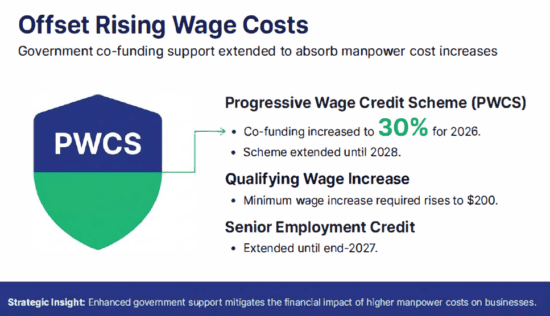
Progressive Wage Credit Scheme (PWCS)
- Co-funding rate increased from 20% to 30% for 2026
- Scheme extended by two more years, until 2028
- From 2027, the minimum qualifying wage increase rises to $200 (up from $100)
Senior Employment Credit
- Extended until end-2027
- Supports employers who retain senior workers
Action required: Ensure eligible local employees receive a qualifying wage increase to unlock PWCS co-funding. Apply through the relevant government portals.
Support for Overseas Expansion
Budget 2026 significantly boosts internationalization support, making this one of the most compelling budgets for SMEs looking to grow regionally and globally.
Double Tax Deduction for Internationalization (DTDi)
- Automatic qualifying cap raised from $150,000 to $400,000
- 200% tax deduction on eligible internationalization spend
Market Readiness Assistance (MRA) Grant
- Support level increased to up to 70% for SMEs
- Expanded scope: Now covers deepening presence in existing markets, not just new market entry
Enterprise Financing Scheme (EFS)
- Maximum loan quantum increased for both trade loans and SME fixed asset loans
Action required: If you are exploring or already present in overseas markets, tap MRA and DTDi now. The raised caps mean significantly more eligible expenditure qualifies automatically.

Bigger Access to Capital
The EFS enhancements give SMEs more room to borrow for growth:
- Trade Loans — Higher trade financing quantum available to support larger inventory and trade volumes
- SME Fixed Asset Loans — Higher quantum to fund equipment, machinery, and facility investment
These changes give businesses more flexibility to invest in growth without being constrained by previous financing ceilings.

AI and Innovation - Tax Incentives
Budget 2026 makes a decisive pivot toward AI adoption. The government wants every SME to start benefiting from AI, and is making it financially attractive to do so.
Enterprise Innovation Scheme (EIS) — Expanded
- AI-related expenditures now qualify as an eligible activity
- 400% tax deduction on qualifying AI spend
- Capped at $50,000 per YA, applicable for YA 2027 and 2028
Productivity Solutions Grant (PSG)
- Expanded to cover a wider range of AI-enabled digital solutions
New: Champions of AI Programme
- Tailored support for businesses that commit to comprehensive AI-led business transformation
- Includes enterprise transformation support and workforce training
Action required: Identify AI tools and platforms your business is already using or plans to adopt. Expenditures from YA 2027 may qualify for the 400% deduction under EIS. Plan ahead.

Workforce Tightening in 2027–2028
Budget 2026 also signals the next wave of foreign workforce policy tightening. Plan for these now if you rely on S Pass or Employment Pass holders for labor.
January 2027 — New Minimum Qualifying Salaries
| Pass Type | Current | From Jan 2027 |
|---|---|---|
| Employment Pass (EP) | $5,600 | $6,000 |
| S Pass | $3,300 | $3,600 |
(Financial services sector EP threshold: $6,200 → $6,600; S Pass: $3,800 → $4,000)
Renewal applications will be affected one year later, from 2028.
2028 — Work Permit Levy Adjustments
- Marine & Process sectors: Levies for basic-skilled workers to increase
- Manufacturing & Services sectors: Tiered levy structure to be simplified
Action required: If you have long-term contracts with manpower costs, price in these new baselines today. Budget for higher pass qualifying salaries before renewals kick in.
Summary: Budget 2026 SME Action Checklist
| Priority | Action | Benefit |
|---|---|---|
| Cash Flow | Review YA 2026 tax payable | 40% CIT rebate or min. $1,500 payout |
| Compliance | Raise local wages before July 2026 | Maintain foreign worker quota eligibility |
| Wage Support | Qualify for PWCS co-funding | 30% government co-funding on wage increases |
| Growth | Apply for MRA & DTDi | Up to 70% grant + 200% tax deduction |
| Innovation | Adopt AI-enabled solutions | 400% tax deduction under EIS (YA 2027–2028) |
| Planning | Price in 2027 pass salary floors now | Avoid cost surprises on contract renewals |

Need Financing to Act on Budget 2026?
We help Singapore SMEs access fast, flexible financing for business loan and SME loans. So you can move quickly on growth opportunities, manage cash flow, and stay compliant as costs evolve.
Whether you need working capital, trade financing, or fixed asset loans aligned with the enhanced Enterprise Financing Scheme, we can help you find the right solution.
Disclaimer: This article is prepared for general informational purposes only. It does not constitute financial, legal, or tax advice. While every effort has been made to ensure accuracy, information may be subject to change. For full details, please refer to official source: singaporebudget.gov.sg for the latest official details.