Singapore Food Manufacturers Under Siege From Impact of the Iran War
Table of Contents
The Perfect Storm
In a recent Business Times article, it is reported that Singapore's food manufacturing sector is facing one of its most difficult operating environments in recent memory.
The ongoing conflict in the Middle East has triggered a cascade of cost pressures that go far beyond what many businesses had planned for.
Rising diesel prices, disrupted shipping routes, squeezed packaging supply chains, and the looming threat of higher electricity and gas tariffs are hitting simultaneously, and there is no quick end in sight.
This is not merely an industry problem. Food manufacturing contributes over 1% of Singapore's GDP, with a substantial share of output going to export markets.
When this sector hurts, the ripple effects touch employment, inflation, and consumer wallets across the economy.
Chain Reaction: How the Middle East Conflict Reaches The Factory Floor
The mechanism is straightforward but brutal. The war has effectively shut down the Strait of Hormuz, a narrow waterway through which roughly 20% of the world's oil and liquefied natural gas (LNG) passes.
Choke that channel, and energy prices spike globally. That spike then travels downstream into nearly every input cost a manufacturer faces.

What the Numbers Mean on the Ground
The companies quoted in the Business Times article are not fringe players. TSK Foods, Tai Hua Food Industries, Tee Yih Jia, You Tiao Man, and Sin Mui Heng collectively represent a wide cross-section of Singapore's food manufacturing ecosystem, from household staples to globally exported products.
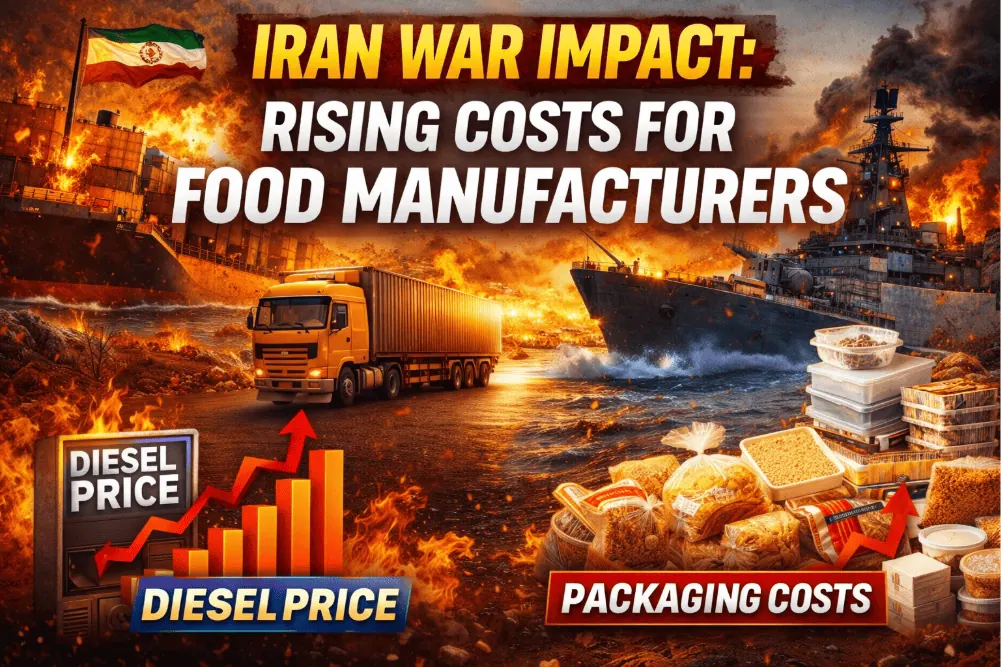
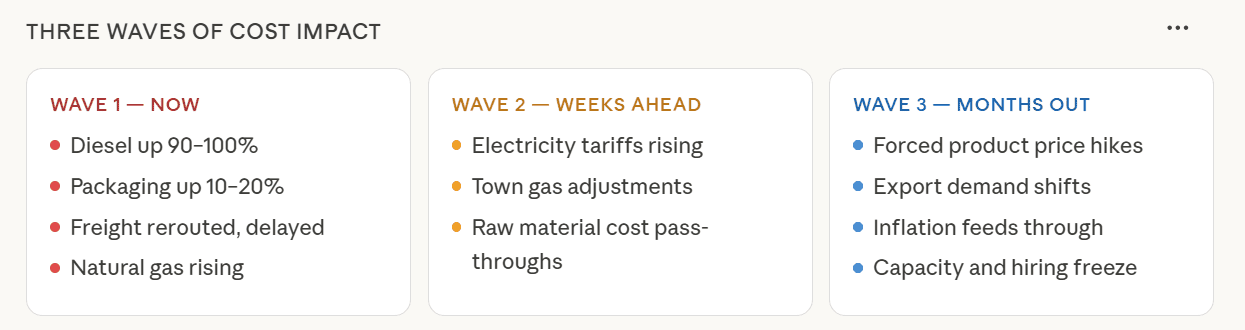
Industrial diesel prices have doubled almost overnight, up 90 to 100%.
For manufacturers who rely on diesel-fired boilers to cook, steam, or process food, this is not a line item to tweak on a spreadsheet. It is an existential cost hitting production every single day.
Tai Hua, which produces soya sauce, tried to pivot its boilers from diesel to natural gas to manage the spike, only to receive notice that natural gas prices are also heading up. That kind of one-two punch leaves businesses with nowhere to manoeuvre.
Smaller operators like You Tiao Man feel it even more acutely. Their diesel-related costs have risen roughly 81%, and packaging suppliers are also pushing through price hikes of 10 to 20%.
For a lean operation without deep cash reserves, absorbing that kind of compounding increase week after week is genuinely unsustainable.
On the logistics front, shipping routes are being redirected away from the Red Sea, which adds transit time, freight cost, and unpredictability.
For food manufacturers with perishable products or time-sensitive export commitments, delays are not just costly; they can mean spoilage, lost orders, and damaged buyer relationships.
The Costs That Have Not Arrived Yet
What makes this situation particularly serious is that, in the words of several manufacturers, "the full effects have not surfaced yet."
Electricity prices in Singapore are expected to rise, a consequence of higher LNG prices globally. For food factories running around the clock, electricity is often the single largest utility cost.
Town gas prices are also flagged as being on the move. These are not distant possibilities. The government has already signalled they are coming.
The picture that emerges is a sector not just dealing with a cost spike, but potentially navigating a sustained period of margin compression, planning uncertainty, and reduced capacity to invest, hire, and grow.
Our View: This Is a Financing Moment, Not Just an Operations Moment
What this article captures is a classic pattern in SME stress events: costs hit first, revenues adjust later, and the gap in between is where businesses get into trouble.
Businesses that have prepared financing buffers in advance are the ones positioned to act on that advice rather than simply read it.
There is also a real opportunity here, not just a threat. Companies that can maintain supply continuity while competitors struggle will likely emerge with stronger buyer relationships and market share.
That kind of competitive positioning only comes to businesses that have liquidity when others do not.
Is Your Business Ready for a Prolonged Cost Environment?
If you are running an SME in Singapore, whether in food manufacturing, logistics, retail, or any sector exposed to energy and supply chain costs, the pressures described in this article are unlikely to resolve quickly.
Planning for the next three to six months with adequate business financing in place is not overcautious. It is smart business.
Linkflow Capital works with Singapore SMEs to structure working capital solutions that are practical, fast to deploy, and customized to your actual business needs.
Whether you need a buffer to manage rising input costs, funding to lock in forward contracts, or capital to invest in efficiency improvements, we help you assess your SME loan options without commitment.
The time to arrange a financing buffer is before you need it urgently, not during the crisis.